Signed in as:
filler@godaddy.com

Players learn to recognize what the game requires rather than forcing predetermined solutions.
They must increasingly understand when to attack, combine, protect possession, accelerate the game, slow it down, take a risk, or choose the more efficient option.
The best decision is not always the most complicated one.
Performance means repeated
Players learn to recognize what the game requires rather than forcing predetermined solutions.
They must increasingly understand when to attack, combine, protect possession, accelerate the game, slow it down, take a risk, or choose the more efficient option.
The best decision is not always the most complicated one.
Performance means repeatedly selecting actions that help the player and the team succeed.
At higher levels, recognizing the solution is only part of the problem.
Players must execute while facing greater speed, physical pressure, fatigue, limited space, and stronger opposition.
Technical quality must survive the demands of the game.
Receiving, dribbling, passing, finishing, defending, and movement are trained with an increasing e
At higher levels, recognizing the solution is only part of the problem.
Players must execute while facing greater speed, physical pressure, fatigue, limited space, and stronger opposition.
Technical quality must survive the demands of the game.
Receiving, dribbling, passing, finishing, defending, and movement are trained with an increasing expectation of precision and consistency under realistic pressure.
As players approach higher levels, their role within the game becomes increasingly important.
Training should expose players to situations that reflect the actions they repeatedly encounter in competition.
Wide players may need to create separation, attack isolated defenders, combine around the box, and deliver or finish.
Central players may
As players approach higher levels, their role within the game becomes increasingly important.
Training should expose players to situations that reflect the actions they repeatedly encounter in competition.
Wide players may need to create separation, attack isolated defenders, combine around the box, and deliver or finish.
Central players may need to receive under pressure, break lines, control tempo, and defend transitions.
Forwards may need to create space, finish quickly, combine around goal, and press effectively.
Defenders may need to dominate individual duels, defend space, play through pressure, and make decisions in transition.
The player remains an individual, but development becomes increasingly connected to how that individual influences the game from their role.
The game at this stage demands more physically and mentally.
Players must be capable of performing actions repeatedly, recovering between efforts, competing through fatigue, and maintaining concentration when the game becomes difficult.
Speed, acceleration, change of direction, strength, coordination, and soccer-specific movement increasing
The game at this stage demands more physically and mentally.
Players must be capable of performing actions repeatedly, recovering between efforts, competing through fatigue, and maintaining concentration when the game becomes difficult.
Speed, acceleration, change of direction, strength, coordination, and soccer-specific movement increasingly support technical and tactical performance.
Players must also develop the resilience to handle mistakes, pressure, competition, and the increased expectations of higher-level environments.
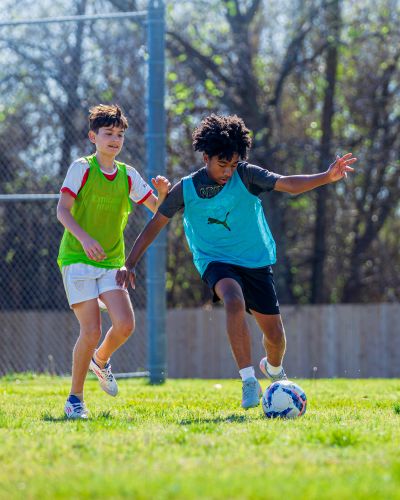
Development does not end at U18.
The objective of the Performance Phase is to prepare players with the tools, understanding, and independence necessary to continue developing within whatever environment comes next.
The Performance Phase is the final stage of the Next Touch Academy youth-development pathway, but it is not necessarily the end of the player's soccer pathway.
For some players, the next environment may be college soccer.
For others, it may involve professional development environments, senior amateur competition, or other opportunities within the game.
Different players will progress through different routes and at different speeds.
There is no single club, league, college division, or youth platform that guarantees the next level.
By this stage, the player's competitive environment becomes increasingly important, but the underlying requirement remains the same:
The player must be capable of performing within it.
Next Touch's role is to help players develop the individual quality, decision-making, physical readiness, and competitive independence necessary to meet the demands of increasingly difficult environments.