Signed in as:
filler@godaddy.com
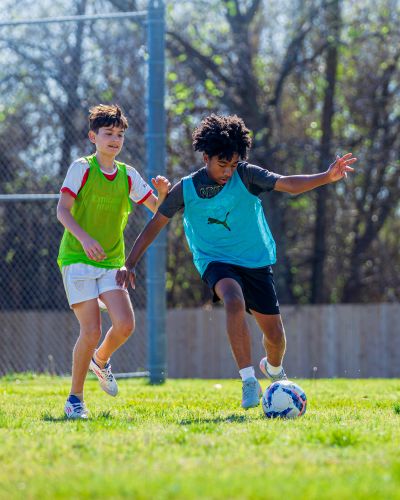
At this stage, the priority should be the player—not the league.
Young players need opportunities to develop:
Families should be careful not to mistake early team status for long-term player development.
The future pathway will become more important later.
Right now, the objective is to build the player who will eventually enter it.
NTSA Focus: individual ability, 1v1 confidence, and simple game problems.
The competitive landscape begins becoming more visible.
Players may enter stronger club environments, Pre-ECNL structures, Girls Academy developmental platforms, or other increasingly selective teams.
But this stage remains fundamentally developmental.
Players need to become capable of:
A higher-level environment creates new problems.
The player's development determines whether she can solve them.
NTSA Focus: situational 1v1 mastery, speed of action, and increasingly complex game problems.
At U13–U15, the external pathway becomes significantly more important.
This is where major national platforms such as ECNL Girls and Girls Academy become increasingly relevant.
Players may experience stronger regional and national competition, showcases, talent identification, and increasingly demanding club environments.
Technical skill must now survive against stronger opposition.
Players need to:
The objective should not simply be gaining access to a particular league.
It should be becoming capable of performing when that access is earned.
NTSA Focus: creativity, individual performance, and creating meaningful advantages.
For many girls, U16–U18 is when the pathway becomes increasingly connected to college recruiting.
Players may also encounter opportunities within pre-professional, professional-development, senior-team, or national-team environments.
At this stage, the player's goals should become increasingly individualized.
Players need to:
The question is no longer simply whether the player has potential.
The player must increasingly demonstrate performance.
NTSA Focus: Performance Phase — decision-making, execution, role-specific actions, and preparation for the next environment.

The Girls Academy now includes multiple developmental levels:
Inspire
An introductory U11–U12 Girls Academy environment.
↓
Aspire
A second-tier competitive platform providing another pathway within the GA ecosystem.
↓
Girls Academy
The top national platform, primarily serving U13–U19 players.
The broader ecosystem is designed to create connecti
The Girls Academy now includes multiple developmental levels:
Inspire
An introductory U11–U12 Girls Academy environment.
↓
Aspire
A second-tier competitive platform providing another pathway within the GA ecosystem.
↓
Girls Academy
The top national platform, primarily serving U13–U19 players.
The broader ecosystem is designed to create connections between developmental and elite competition rather than beginning the pathway only at the older ages.

ECNL is a major platform that includes:
Pre - ECNL -> ECNL Regional League -> ECNL Girls
Players in these environments can experience strong regional and national competition, showcase events, and significant exposure to college programs.
The ECNL Regional League also provides a pathway through which high-performing clubs can progress toward the top ECNL platform.

The Development Player League has become formally connected to the Girls Academy ecosystem and can provide another route toward Aspire and Girls Academy environments.
Other strong regional and local competitions also remain part of the landscape.
A player does not stop developing simply because she is outside one of the largest national pla
The Development Player League has become formally connected to the Girls Academy ecosystem and can provide another route toward Aspire and Girls Academy environments.
Other strong regional and local competitions also remain part of the landscape.
A player does not stop developing simply because she is outside one of the largest national platforms.
Quality of coaching, meaningful playing time, competitive level, training environment, and the player's individual growth all matter.

USL-connected environments provide another developing route within the female game.
USL Academy structures can connect youth players with senior-team environments, while the wider USL women's ecosystem includes professional and pre-professional opportunities.
For certain high-level players, Academy contracts can provide senior-team experien
USL-connected environments provide another developing route within the female game.
USL Academy structures can connect youth players with senior-team environments, while the wider USL women's ecosystem includes professional and pre-professional opportunities.
For certain high-level players, Academy contracts can provide senior-team experience while preserving applicable college eligibility.
These opportunities remain highly selective, but they demonstrate that the girls pathway is increasingly extending beyond the traditional youth club → college model.
College soccer remains one of the most significant pathways for female players in the United States.
Opportunities exist across:
NCAA Division I
NCAA Division II
NCAA Division III
NAIA
Junior College
There is significant variation even within each level.
A strong Division II or Division III program may provide a better athletic, academic, or
College soccer remains one of the most significant pathways for female players in the United States.
Opportunities exist across:
NCAA Division I
NCAA Division II
NCAA Division III
NAIA
Junior College
There is significant variation even within each level.
A strong Division II or Division III program may provide a better athletic, academic, or developmental fit for a particular player than some Division I programs.
Recruiting depends on much more than league affiliation.
College coaches evaluate factors such as:
Players and families should begin understanding eligibility and recruiting requirements before the final year of high school.
Academic preparation matters alongside soccer development.
The objective should not simply be collecting the highest possible division label.
It should be finding an environment where the player can develop, compete, study, and succeed.
The women's professional pathway in the United States continues to evolve.
Players may eventually reach professional environments through different routes, including:
Elite youth soccer → college → professional soccer
Elite youth soccer → professional-development or senior environment
USL Academy pathway → senior opportunities
Youth or college
The women's professional pathway in the United States continues to evolve.
Players may eventually reach professional environments through different routes, including:
Elite youth soccer → college → professional soccer
Elite youth soccer → professional-development or senior environment
USL Academy pathway → senior opportunities
Youth or college soccer → national-team identification → professional opportunities
Unlike the boys side, the girls pathway has historically been particularly connected to college soccer, although more direct youth-to-senior opportunities continue to develop.
Professional soccer remains an extremely selective destination.
The objective at younger ages should therefore not be to prematurely build every decision around becoming professional.
It should be to develop a player capable of continuing to move forward as opportunities become available.