• Pitch
  • Pathways
    • Pre Academy
    • Foundation Phase| U7 - U9
    • Application Phase|U10-U12
    • Expression Phase|U13-U15
    • Performance Phase|U16-U18
    • Boys Pathway
    • Girls Pathway
  • Membership
    • Academy Membership
    • Schedule & Booking
    • Online Support
  • Next Touch Standard
  • Private Training
  • Camps & Events
    • Camps/ Intensives
    • Futsal
  • About
    • Coach's Corner
    • FAQ
    • Contact
    • Results
  • More
    • Pitch
    • Pathways
      • Pre Academy
      • Foundation Phase| U7 - U9
      • Application Phase|U10-U12
      • Expression Phase|U13-U15
      • Performance Phase|U16-U18
      • Boys Pathway
      • Girls Pathway
    • Membership
      • Academy Membership
      • Schedule & Booking
      • Online Support
    • Next Touch Standard
    • Private Training
    • Camps & Events
      • Camps/ Intensives
      • Futsal
    • About
      • Coach's Corner
      • FAQ
      • Contact
      • Results
  • Sign In
  • Create Account

  • Bookings
  • My Account
  • Signed in as:

  • filler@godaddy.com


  • Bookings
  • My Account
  • Sign out

Book Now

Signed in as:

filler@godaddy.com

  • Pitch
  • Pathways
    • Pre Academy
    • Foundation Phase| U7 - U9
    • Application Phase|U10-U12
    • Expression Phase|U13-U15
    • Performance Phase|U16-U18
    • Boys Pathway
    • Girls Pathway
  • Membership
    • Academy Membership
    • Schedule & Booking
    • Online Support
  • Next Touch Standard
  • Private Training
  • Camps & Events
    • Camps/ Intensives
    • Futsal
  • About
    • Coach's Corner
    • FAQ
    • Contact
    • Results

Account

  • Bookings
  • My Account
  • Sign out

  • Sign In
  • Bookings
  • My Account
Book Now

EXPRESSION PHASE | U13 - U15

Developing creative, decisive players who can create and exploit advantages against stronger opposition.


At U13–U15, the game becomes faster, more physical, and increasingly position-specific.

Players have less space and time.

Opponents are more capable of recognizing and stopping predictable actions.

Technical ability alone is no longer enough.

Players must learn to use their individual qualities with greater awareness, deception, timing, and purpose.

The challenge becomes whether a player can create an advantage and make it matter against increasingly difficult opposition.

Book a Trial

What this phase is about

The Expression Phase builds on the individual ability and situational understanding developed during the earlier stages of the pathway.

Players should now be capable of solving many basic game problems.

The next step is learning to influence the game more consistently.

That may mean manipulating a defender before attacking.

Receiving in a way that eliminates pressure.

Creating separation in a tight space.

Drawing an opponent to release a teammate.

Recognizing when to accelerate the game and when to protect the advantage already created.

Players are encouraged to develop their own solutions rather than becoming dependent on predetermined patterns.

Creativity is not simply performing unusual skills.

It is the ability to perceive opportunities, manipulate opponents, and produce effective solutions the game demands.

PRIMARY development priorities

1V1 PERFORMANCE

CREATIVITY & DECEPTION

CREATIVITY & DECEPTION

Individual ability must now survive against faster, stronger, and more experienced defenders.

Players continue developing their attacking and defending qualities through increasingly realistic situations involving space, pressure, direction, support, and the goal.

The emphasis shifts from simply being capable of performing an action to performing it consistently when the game demands it.

CREATIVITY & DECEPTION

CREATIVITY & DECEPTION

CREATIVITY & DECEPTION

Players learn to manipulate opponents through changes of speed, body position, movement, timing, disguise, and technical execution.

Rather than relying on rehearsed solutions, players are challenged to recognize what the defender gives them and create an appropriate response.

Creativity becomes a tool for creating advantages.

POSITION-RELEVANT PROBLEMS

As players mature, the areas of the field and situations they encounter become increasingly relevant.

Wide players may repeatedly face isolated defenders.

Central players may need to receive and escape pressure from multiple directions.

Attackers may need to create separation around goal.

Defenders may need to solve space behind them, individ

As players mature, the areas of the field and situations they encounter become increasingly relevant.

Wide players may repeatedly face isolated defenders.

Central players may need to receive and escape pressure from multiple directions.

Attackers may need to create separation around goal.

Defenders may need to solve space behind them, individual duels, and transition moments.

Training begins connecting individual development more closely to the situations players actually experience in competition.

CREATING & EXPLOITING ADVANTAGES

Players learn that creating an advantage is only the beginning.

Once space, separation, or numerical superiority has been created, the player must recognize how to exploit it.

That could mean carrying the ball forward, combining, finishing, finding the free player, or immediately attacking an exposed defense.

The goal is to turn individual quality into meaningful influence on the game.
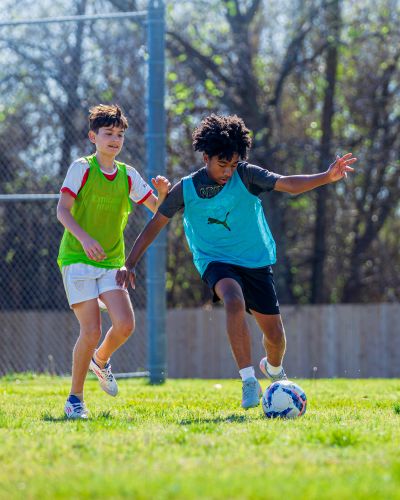
WHAT TRAINING LOOKS LIKE

Players will regularly experience:

  • position-relevant 1v1 attacking and defending
  • receiving and turning under pressure
  • 1v1s with recovering or secondary defenders
  • 1v1 + support-player situations
  • 1v2, 2v1, 2v2, and 3v2 problems
  • overloads and underloads
  • combination play in tight spaces
  • attacking and defensive transitions
  • final-third attacking situations
  • finishing under pressure
  • counterattacking and counter-pressing moments
  • directional and position-relevant small-sided games
  • competitive game play

Expression Phase training is built around competitive, game-realistic problems that demand creativit

Technical development continues, but the standard becomes increasingly demanding.

Players must execute while scanning, adjusting to opponents, managing pressure, and recognizing how the situation is changing around them.

Training should provide enough structure to create the problem while giving players enough freedom to find their own solution.

why this phase matters

By the end of this phase, players should increasingly be able to:

  • receive and play effectively under pressure
  • recognize pressure before receiving the ball
  • create separation against stronger defenders
  • manipulate opponents through movement, deception, timing, and changes of speed
  • attack defenders from position-relevant situations
  • protect possession while searching for a better solution
  • recognize when to take responsibility individually and when to combine
  • create and exploit numerical or positional advantages
  • play through, around, or away from pressure
  • recognize opportunities to accelerate the attack
  • create and finish chances in the final third
  • transition quickly between attacking and defending
  • defend effectively in individual and small-unit situations
  • adapt their solution when the first option is removed
  • express individual qualities without becoming disconnected from the needs of the game
  • perform with increasing consistency against high-level opposition

Development will not look identical for every player.

The goal is for players to develop an increasingly recognizable individual game while becoming more effective within the collective game around them.

TRANSITION TO U16 - U18

U15 serves as an important transition year within the pathway.

During the Expression Phase, players are encouraged to expand their ability to create, manipulate, and solve increasingly difficult game problems.

As they move toward the Performance Phase, the standard begins to change again.

Solutions must become more efficient.

Execution must become more consistent.

Decisions carry greater consequences.

Physical and tactical demands increase.

Players have to understand not only what they are capable of doing, but what the game requires in that moment.

The question begins to shift from:

“Can I create and exploit an advantage?”

to:

“Can I consistently make the action that helps me and my team perform?”

That transition leads into the U16–U18 Performance Phase.

WHERE THIS FITS IN THE SOCCER PATHWAY

At U13–U15, the competitive environment becomes increasingly significant.

Players may now be competing in higher-level regional and national environments where the speed of play, physical demands, and quality of opposition rise considerably.

Different players will follow different competitive pathways.

There is no single league, club, or platform that guarantees long-term development.

The player's environment matters, but so does their ability to actually perform within it.

The Expression Phase prepares players for higher levels by developing individual qualities that can withstand stronger opposition while helping players understand how those qualities influence the larger game.

This is also an age where the boys' and girls' competitive pathways begin to become increasingly important for families to understand.

Explore Boys/ Girls Pathway

Training at NTSA

Academy Development Training

Advanced Final Phase Training

Advanced Final Phase Training

The primary weekly environment for building individual quality and situational understanding.

Advanced Final Phase Training

Advanced Final Phase Training

Advanced Final Phase Training

Eligible players may access higher-level Friday training centered around attacking and defending the goal, 1v1 performance, finishing, combinations, transitions, and competitive final-third situations.

Private & Hybrid Training

Futsal, Camps & Intensives

Futsal, Camps & Intensives

Targeted training can address specific technical, athletic, positional, or performance needs alongside the player's Academy and club environments.

Futsal, Camps & Intensives

Futsal, Camps & Intensives

Futsal, Camps & Intensives

Additional development opportunities offered throughout the year

CREATE THE ADVANTAGE. MAKE IT MATTER.

View Membership Options

Copyright © 2026 Next Touch Academy - All Rights Reserved.

Powered by

  • FAQ
  • Terms + Privacy Policy
  • Training Program Policies

This website uses cookies.

We use cookies to analyze website traffic and optimize your website experience. By accepting our use of cookies, your data will be aggregated with all other user data.

Accept