Signed in as:
filler@godaddy.com

Players learn to attack and defend opponents in different spaces, directions, and situations.
The emphasis is not simply on learning moves, but on understanding how changes of speed, direction, body position, deception, and the ball can be used to create an advantage.
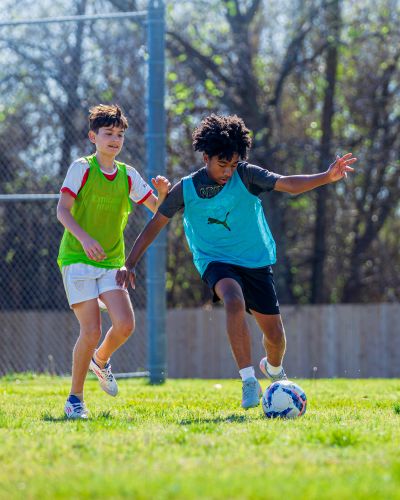
Players learn how to keep the ball when pressured, use their body effectively, change direction, and escape into available space.
Possession begins with the individual player's ability to handle pressure.
Players begin recognizing when space is available and developing the confidence to attack it.
We want young players who look forward, carry the ball with purpose, and recognize opportunities to advance the game.
Players are encouraged to compete, take risks, recover from mistakes, and try again.
Confidence is developed through repeated experiences solving real problems—not by avoiding difficult situations.
Development is not expected to look identical for every player.
The goal is continued growth toward these behaviors as players prepare for the next stage of the pathway.
U9 serves as an important transition year within the pathway.
During the Foundation Phase, much of the player's development centers on solving individual and simple small-number problems.
As players move toward the Application Phase, those same skills must begin surviving in faster and more complex situations.
There are more players.
Pressure arrives sooner.
Space becomes smaller.
Decisions become more connected.
The question begins to change from:
“Can I solve the defender in front of me?”
to:
“Can I recognize and solve the situation developing around me?”
That transition leads into the U10–U12 Application Phase.
At U7–U9, long-term development should matter more than chasing league labels or status.
Players will compete in different clubs, leagues, and formats, but the most important question at this stage is whether the player is developing the individual tools they will need later.
Higher levels of the game eventually demand faster decisions, stronger opposition, and greater tactical understanding.
The Foundation Phase begins preparing players for those future demands by developing the player before specializing in the pathway around them.