Signed in as:
filler@godaddy.com

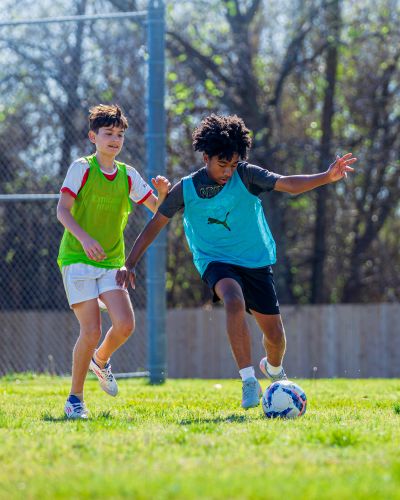
Players continue developing their ability to attack and defend 1v1, but the situations become more specific and demanding.
Players learn to solve pressure from different angles, receive before attacking, create separation, protect possession, and recognize when an individual action can create an advantage for the team.
As the game becomes faster, players have less time to see, decide, and execute.
Training challenges players to recognize information earlier, play with greater purpose, and perform technical actions under increasing pressure.
Speed is not simply running faster.
It is seeing the game earlier and acting sooner.
Players increasingly encounter 2v1, 1v2, 2v2, 3v2, and other small-number situations.
They begin learning how individual ability and combination play work together.
The player should become comfortable deciding when to take responsibility individually and when another player creates the better solution.
Players learn to react quickly when possession changes.
Winning the ball should create an immediate opportunity to attack.
Losing the ball should create an immediate responsibility to recover, pressure, or protect space.
Players are encouraged to recognize opportunities to move the game forward rather than simply keeping possession without purpose.
Development will not look identical for every player.
The goal is for players to become increasingly capable of applying their individual qualities inside the changing demands of the game.
U12 serves as an important transition year within the pathway.
During the Application Phase, players learn to use their individual ability inside increasingly complex situations.
As they move toward the Expression Phase, the standard becomes higher.
Opponents become stronger.
Spaces become more position-specific.
Mistakes are punished faster.
Players are expected to recognize advantages earlier and execute solutions more consistently.
The question begins to shift from:
“Can I solve this situation?”
to:
“Can I consistently create and exploit advantages against better opposition?”
That transition leads into the U13–U15 Expression Phase.
At U10–U12, the player's competitive environment begins to matter more.
Players may move into stronger teams, higher-level club environments, larger-sided formats, and more demanding competition.
However, the badge or league should not become the development plan.
A stronger environment only helps when the player has the individual ability to participate effectively within it.
The Application Phase prepares players for higher demands by developing the ability to solve problems faster, under greater pressure, and with more information to process.
As players approach U13, the competitive pathway begins becoming increasingly important.